
Selecting the right bearing is a critical engineering decision that directly influences machine performance, reliability, and total cost of ownership. An undersized bearing fails prematurely under excessive load; an oversized one wastes energy and inflates initial cost. This step-by-step guide distills the selection process into a logical workflow based on established ISO standards and practical field experience, helping engineers and procurement specialists make informed, defensible choices.
Step 1: Define the Load Conditions
Every bearing selection begins with a thorough load analysis. Bearings must support two primary types of forces:
- Radial load (Fr) – perpendicular to the shaft axis.
- Axial load (Fa) – parallel to the shaft axis.
Determine the magnitude and direction of both the static and dynamic forces the bearing will encounter. Often, loads vary over a duty cycle, so calculate an equivalent dynamic load (P) using the standard formula from ISO 281:
P = X · Fr + Y · Fa
Here, X and Y are radial and axial factors obtained from bearing manufacturers’ catalogues. For combined loads, this step is essential because it directly determines the required dynamic load rating (C) in the next phase.
Step 2: Calculate the Required Basic Dynamic Load Rating (C)
Once you have the equivalent dynamic load P, you can establish the minimum required dynamic load rating using the bearing life equation:
L₁₀ = (C / P)^p (in millions of revolutions)
where p = 3 for ball bearings and p = 10/3 for roller bearings.
The L₁₀ life represents the number of revolutions that 90% of a sufficiently large group of identical bearings will complete or exceed under the same load conditions. Most industrial applications target an L₁₀ life between 10,000 and 50,000 hours. Convert the desired life in hours to millions of revolutions based on operating speed, then solve for C:
C_req = P · (L₁₀_req)^(1/p)
Select a bearing with a catalogue dynamic load rating C ≥ C_req. Remember to apply application-specific safety factors for shock loads or unknown conditions.
Step 3: Check the Static Load Rating (C₀)
Beyond fatigue life, the bearing must withstand peak static or shock loads without permanent deformation. The static load rating C₀ ensures that the total plastic deformation at the most heavily loaded contact point does not exceed 0.0001 times the rolling element diameter. Verify that the static equivalent load P₀ (calculated similarly with static factors X₀, Y₀) meets:
s₀ = C₀ / P₀
The static safety factor s₀ should be at least 2 for smooth running conditions, and can go up to 4 or more for severe shock loads. Never neglect this check – a single overload event can brinell raceways and destroy a bearing instantly.
Step 4: Determine the Appropriate Bearing Type
With load ratings in hand, now select the bearing type that matches the load characteristics and kinematic requirements. Key type selection criteria include:
- Глубокие канавочные шариковые подшипники – suitable for radial and moderate axial loads in both directions; excellent for high speeds.
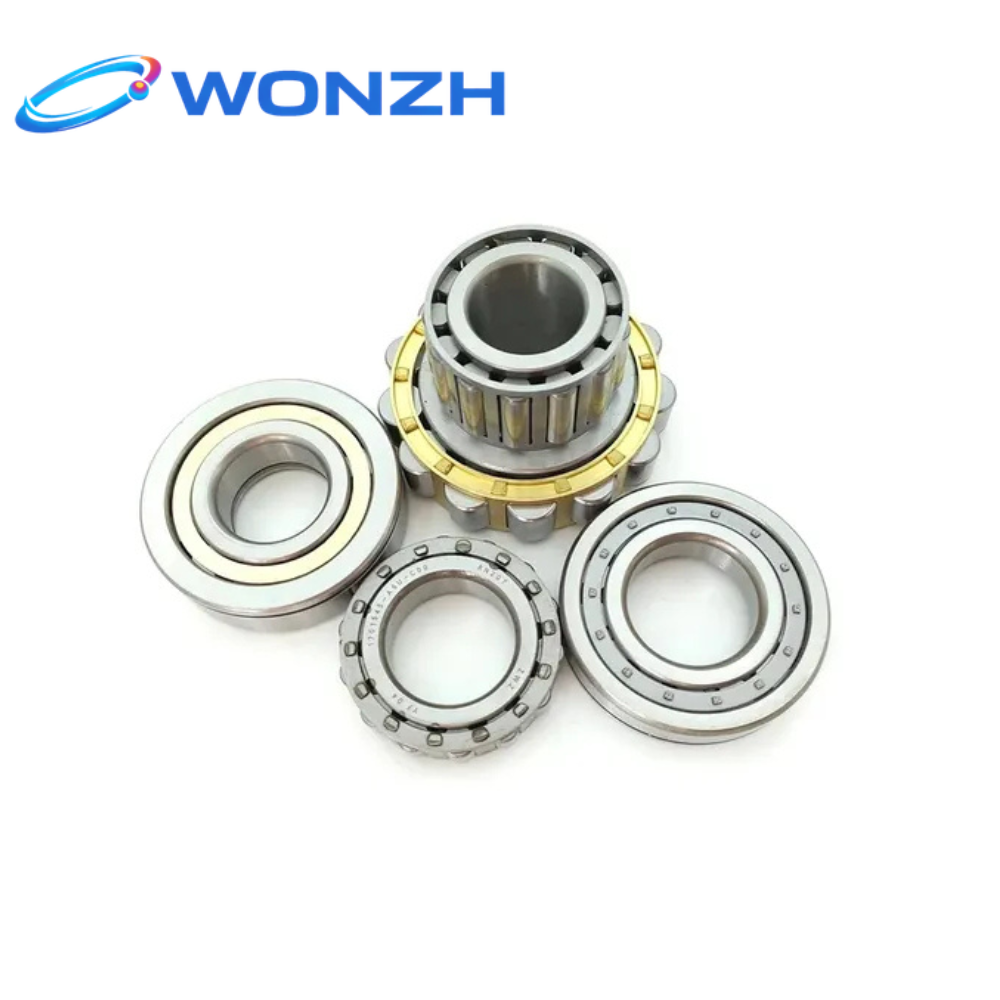
- Цилиндрические роликовые подшипники – high radial load capacity, limited axial capability (unless designed with lips).
- Конусные роликовые подшипники – handle combined radial and heavy axial loads; commonly used in wheel hubs and gearboxes.
- Шариковые подшипники с угловым контактом – support combined loads and can be arranged in pairs for precise shaft positioning.
- Сферические роликовые подшипники – compensate for misalignment and handle very high radial loads with decent axial capacity.
- Thrust bearings – purely for axial loads.
Consider available mounting space, speed limits, and the need for angular stiffness.
Step 5: Account for Speed, Temperature, and Environment
The operating environment heavily influences material choice, lubrication, and sealing.
- Скорости: Compare the selected bearing’s limiting speed (typically given for grease and oil lubrication) with the application speed. For high-speed spindles, consider precision angular contact ball bearings or hybrid ceramic bearings.
- Температура: Standard chrome steel bearings (100Cr6) can operate up to 120–150°C. Beyond that, dimensional stabilisation and special heat treatment are required. High-temperature greases or solid lubricants become essential.
- Contamination and moisture: In food processing, marine, or chemical environments, stainless steel or ceramic rolling elements with appropriate seals should be chosen. Contact seals (e.g., 2RS) offer good protection but increase friction; non-contact shields (ZZ) suit cleaner high-speed applications.
Step 6: Specify Lubrication, Seals, and Internal Clearance
The final selection details often determine actual service life.
- Смазка: Grease is the default for many applications due to simplicity. Calculate relubrication intervals or set up a continuous oil system for high-speed or high-temperature cases. The correct grease viscosity at operating temperature is crucial.
- Sealing/Shielding: Choose between open, shielded (ZZ), or sealed (2RS, 2RZ) configurations based on the contamination risk and the need for regreasing.
- Internal clearance (C3, C4, etc.): Fit and thermal expansion dictate radial internal clearance. Shaft and housing fits (h5, H7, etc.) influence the operational clearance. For tight interference fits or large temperature gradients, C3 clearance is a common starting point. Incorrect clearance causes excessive noise, heating, or premature failure.
Step 7: Validate Shaft and Housing Fits and Installation
A perfectly selected bearing can fail quickly if mounted incorrectly. Adhere to the manufacturer’s recommendation for shaft and housing tolerances based on load type (rotating relative to the inner or outer ring). Use assembly tools, avoid hammer blows on rings, and check runout and alignment. Incorporate a maintenance plan – condition monitoring tools such as vibration analysis or temperature sensors can detect early problems.
Заключение
A systematic bearing selection process moves from load analysis, through life calculation, to environmental and fitting considerations. Skipping any step risks overdesign, underdesign, or catastrophic failure. By following this workflow and cross-referencing with the detailed technical data in our bearing catalogue, engineers can confidently specify bearings that meet performance targets and maintain long-term profitability.