
In any rotating machinery, forces rarely act purely in one direction. A pump impeller pushes fluid axially while supporting the shaft weight radially; a helical gear transmission generates both separating and thrust forces; a vehicle wheel bearing must absorb cornering thrust alongside the weight of the chassis. Failing to correctly characterise these forces—and to select a bearing type that is kinematically capable of supporting them—leads to excessive wear, overheating, and catastrophic failure. This article clarifies the distinction between radial and axial loads and provides a systematic method for mapping force directions to the most appropriate bearing configuration.
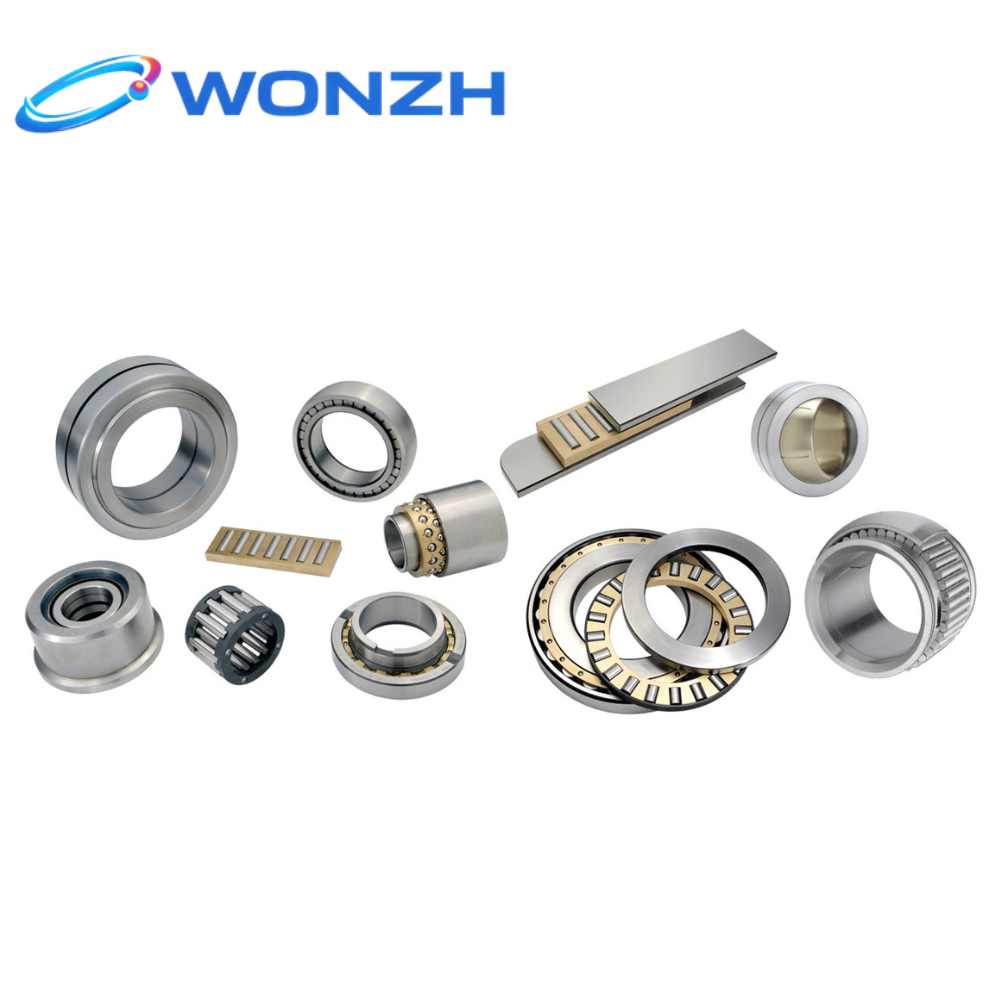
1. Defining Radial and Axial Loads
- Radial load (Fr) acts perpendicular to the shaft centreline. It can originate from the weight of a shaft, belt tension, gear separating forces, or imbalance. Radial forces try to push the shaft sideways.
- Axial load (Fa) , also known as thrust load, acts parallel to the shaft centreline. Common sources include propeller thrust, helical gear forces, inclined conveyors, and pressure differences in pumps or turbines. Axial forces attempt to move the shaft along its axis.
In practice, most applications combine both load components. Engineering analysis must quantify the nominal values of Fr and Fa over the complete duty cycle—including start-stop, overload, and transient conditions—before any selection takes place.
2. How Bearing Types React to Load Directions
Rolling bearings are designed to accept specific load directions based on the geometry of their raceways and rolling elements. Selecting a type incompatible with the load vector is a fundamental error that cannot be compensated for by oversizing.
| Yatak tipi | Pure radial capacity | Axial load capacity (single direction) | Axial load capacity (both directions) | Remarks |
|---|---|---|---|---|
| Deep groove ball bearing | Excellent | Moderate | Moderate (both ways) | The most versatile choice; axial capacity diminishes at very high speeds. |
| Cylindrical roller bearing (NU/N design) | Very high | None | None | Cannot accept axial load unless fitted with guide lips (NJ, NUP designs offer limited unidirectional axial location). |
| Açısal temas bilyalı yatak | Good | High (unidirectional) | Only in paired arrangement (face-to-face, back-to-back, or tandem). | Contact angle (15°, 25°, 40°) dictates the axial capacity ratio. |
| Tapered roller bearing | High | Very high (unidirectional) | Pairs required for bidirectional axial load. | Accommodates combined loads efficiently; inherently separable for easy mounting. |
| Spherical roller bearing | Very high | Moderate (both directions) | Already bidirectional. | Misalignment tolerance is a major additional benefit. |
| Thrust ball bearing | None | High (unidirectional) | Bidirectional with double-row design. | Designed exclusively for axial load; must not carry radial load. |
| Thrust cylindrical / spherical roller bearing | None | Extremely high (unidirectional) | – | For heavy pure thrust applications such as extruders or vertical shafts. |
| Four-point contact ball bearing | Limited radial capacity | High (bidirectional) | Already bidirectional. | Saves space by replacing two angular contact bearings in some applications. |
The table above forms the initial filtering matrix: the bearing type must be physically capable of handling the load directions present in the application. Only after passing this filter should life and static safety calculations proceed.
3. Combined Loads and the Equivalent Dynamic Load
When both radial and axial loads exist, the two components combine into an equivalent dynamic load P that can be compared against the bearing’s catalogue dynamic load rating C. ISO 281 defines the general formula for radial bearings:
P = X · Fr + Y · Fa
The factors X (radial factor) and Y (axial factor) depend on the bearing type and, crucially, on the ratio Fa / Fr. A deep groove ball bearing subjected to a small axial force will behave very differently from the same bearing under a dominant thrust load. Manufacturer catalogues provide detailed tables specifying X and Y for different contact angles and clearance classes. The principal selecting philosophy is:
- When Fa / Fr is small (dominantly radial), deep groove ball bearings or cylindrical roller bearings are likely optimal.
- When Fa / Fr is moderate to high, angular contact ball bearings or tapered roller bearings become necessary to carry the axial component efficiently.
- When Fa / Fr is very large (nearly pure thrust), dedicated thrust bearings must be introduced, and radial support must be provided by a separate radial bearing.
This ratio defines not only the bearing type but also the required contact angle. For angular contact bearings, a 40° contact angle can carry approximately twice the axial load of a 15° bearing of the same size—at the expense of lower speed capability. Tapered roller bearings inherently offer a high force ratio due to their cone angle.
4. Application-Driven Selection Examples
Case A – Electric Motor (horizontal, V-belt drive)
- Belt tension creates a consistent radial pull; the rotor is not axially located against thrust.
- Recommended type: Deep groove ball bearing on the drive end for combined load ability; a cylindrical roller bearing (NU) on the non-drive end to allow thermal shaft expansion while taking pure radial load.
Case B – Worm Gear Reducer Output Shaft
- Worm drive generates massive axial thrust together with gear separating radial load.
- Recommended type: Paired tapered roller bearings arranged in a back-to-back or face-to-face orientation to handle high combined loads and provide rigid shaft positioning. Alternatively, a spherical roller thrust bearing for the pure thrust portion plus a cylindrical roller bearing for radial support.
Case C – Vertical Pump with Impeller Downward Thrust
- Upward hydraulic thrust during start-up, downward thrust during steady operation; minimal radial load.
- Recommended type: Paired angular contact ball bearings (often 40° contact angle) mounted to accept bi‑directional thrust, supported by a deep groove ball bearing at the top for radial stability. In larger pumps, a double-direction thrust ball bearing or spherical roller thrust bearing is preferred.
Case D – Overhead Conveyor Trolley Wheel
- Pure radial load from weight; lateral guidance forces are minimal and intermittent.
- Recommended type: Deep groove ball bearing with C3 clearance and contact seals to accommodate slight shaft deflections and prevent contamination ingress. Cylindrical roller bearings are used only if radial load demands exceed the ball bearing’s static capacity.
5. Special Considerations for Load Direction
- Bidirectional axial loads can be taken by a single bearing type only if the bearing design permits it (e.g., deep groove ball bearing, double-row angular contact bearing, four-point contact bearing, spherical roller bearing). Otherwise, two single-direction bearings must be paired preloaded to eliminate internal clearance and avoid ball skidding.
- Moment loads caused by overhung forces create an uneven axial and radial distribution across the bearing set. In these cases, the distance between two bearings (spread) and their load capacities must be calculated together—a single oversized bearing rarely solves a moment problem.
- Speed and lubrication interact with load selection. High speed may exclude tapered roller bearings because of centrifugal effects on the roller set. Angular contact ball bearings or hybrid ceramic deep groove ball bearings may then be the only options, even if the raw load numbers favour a roller bearing.
6. Stepwise Checklist for Matching Bearing Type to Load Direction
- Identify all force vectors acting on the shaft during normal operation, start-up, shut-down, and overload.
- Separate forces into radial and axial components, and compute the maximum Fr and Fa for each operating phase.
- Determine the dominant load mode: purely radial, purely axial, combined radial‑axial, or combined with significant moment.
- Filter bearing types using the capability table (Section 2); eliminate any type that cannot physically accommodate the axial or radial requirement.
- Calculate the equivalent dynamic load P using the appropriate X and Y factors, selecting the bearing size based on the required life L10.
- Verify static safety for peak shock or static loads using the static equivalent load P0 and static load rating C0.
- Review secondary factors: speed, temperature, lubrication, misalignment, and fit. Adjust clearance class or change type if necessary—e.g., substituting a spherical roller bearing if shaft alignment cannot be guaranteed.
Sonuç
Radial and axial loads are not interchangeable figures; they dictate the very type of bearing that can be used. Overlooking the axial component leads to thrust-induced failure in bearings designed only for radial forces, while applying a deep groove ball bearing where a tapered roller bearing is needed results in shortened life and poor stiffness. By rigorously matching the load direction and the force ratio Fa / Fr to the bearing’s kinematic architecture, engineers create robust rotating assemblies that meet both performance and durability targets.