
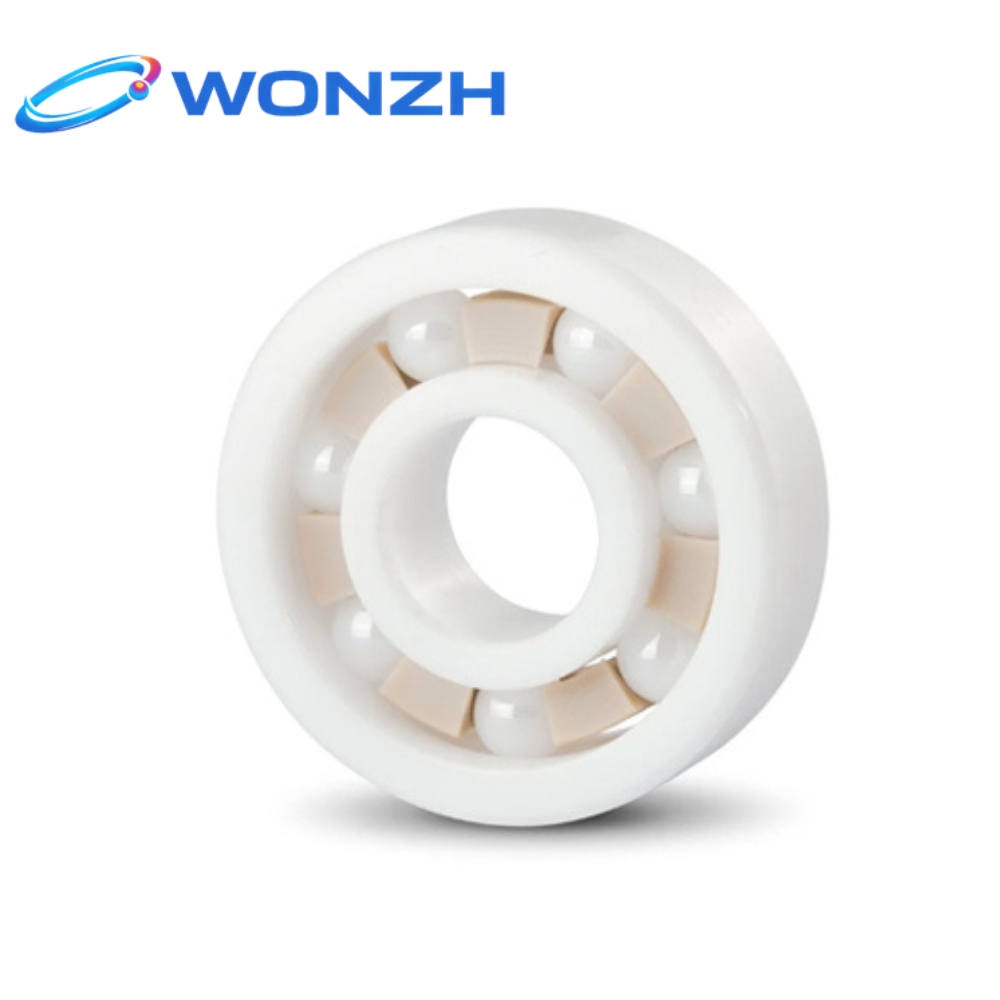
In modern mechanical engineering, high-speed operation is a critical requirement across industries such as aerospace, semiconductor manufacturing, robotics, electric motors, and precision machine tools. As rotational speeds increase, traditional steel bearings often face limitations in terms of heat generation, friction, wear, and lubrication stability. Ceramic bearings, especially those made from advanced materials such as silicon nitride (Si₃N₄), have emerged as a superior solution for high-speed applications due to their unique physical and mechanical properties.
This article provides a technical and scientific overview of why ceramic bearings are increasingly preferred in high-speed operating environments.
1. Lower Density Enables Higher Rotational Speed
One of the most important advantages of ceramic materials is their significantly lower density compared to steel.
Ceramic balls are approximately:
- 40% lighter than steel balls
This reduction in mass leads to lower centrifugal forces during high-speed rotation. As a result:
- Reduced internal stress on bearing components
- Lower friction at high RPM
- Improved stability at extreme rotational speeds
- Reduced risk of ball deformation
This makes ceramic bearings ideal for ultra-high-speed spindles and precision machinery.
2. Reduced Friction and Heat Generation
Friction is one of the primary limiting factors in high-speed bearing systems. Ceramic materials have a smoother surface finish and lower coefficient of friction compared to steel.
At high speeds, ceramic bearings provide:
- Lower rolling resistance
- Reduced heat buildup
- Improved lubrication efficiency
- More stable operating temperature
Qf∝μ⋅Fn⋅v
Where frictional heat generation increases with friction coefficient (μ), normal force (Fn), and velocity (v). Since ceramic materials reduce μ, total heat generation is significantly lower.
This thermal advantage helps prevent lubricant degradation and extends bearing service life.
3. Excellent Wear Resistance and Hardness
Ceramic materials such as silicon nitride offer extremely high hardness, often exceeding that of bearing steel. This results in:
- Superior wear resistance
- Reduced surface fatigue
- Longer operational lifespan
- Better performance under boundary lubrication conditions
Even in high-speed environments where lubrication films may become thin, ceramic bearings maintain stable contact surfaces with minimal degradation.
4. Superior High-Temperature Performance
High-speed operation naturally generates heat. Ceramic bearings maintain mechanical stability at much higher temperatures than steel bearings.
Key advantages include:
- Minimal thermal expansion
- Stable dimensional accuracy
- No material softening at elevated temperatures
- Reduced risk of thermal seizure
This makes ceramic bearings suitable for applications such as high-speed turbines, aerospace components, and high-performance electric motors.
5. Reduced Centrifugal Expansion at High RPM
At high rotational speeds, centrifugal force causes steel balls to expand outward, increasing contact stress and internal friction.
Ceramic bearings reduce this effect due to:
- Lower material density
- Higher stiffness
- Reduced deformation under load
This improves:
- Rotational accuracy
- Stability at extreme speeds
- Vibration control
As a result, ceramic bearings are widely used in precision spindles and CNC machining systems.
6. Improved Electrical Insulation Properties
Unlike steel, ceramic materials are electrically non-conductive. This provides a significant advantage in high-speed electric motor applications.
Benefits include:
- Prevention of electrical pitting
- Reduced risk of current leakage damage
- Improved motor bearing reliability
- Compatibility with variable frequency drives (VFDs)
This is especially important in modern inverter-driven motor systems.
7. Lower Lubrication Requirements
Ceramic bearings operate more efficiently under reduced lubrication conditions due to their:
- Smooth surface finish
- Low friction coefficient
- High wear resistance
In high-speed systems, this leads to:
- Reduced lubricant consumption
- Lower maintenance frequency
- Cleaner operating environments
- Improved reliability in vacuum or cleanroom conditions
This makes them highly suitable for semiconductor and medical equipment applications.
8. Enhanced Corrosion Resistance
Ceramic materials are chemically inert and highly resistant to corrosion. In high-speed industrial environments where exposure to moisture, chemicals, or reactive gases is common, ceramic bearings provide:
- Long-term stability
- No rust formation
- Consistent performance in aggressive environments
This is particularly valuable in chemical processing equipment and marine applications.
9. Reduced Vibration and Noise
High-speed mechanical systems often suffer from vibration and acoustic noise due to dynamic imbalance and material deformation. Ceramic bearings improve system smoothness through:
- Higher stiffness
- Lower rotating mass
- Reduced thermal distortion
This results in quieter and more stable operation, especially in precision machinery and medical devices.
10. Applications in High-Speed Industries
Due to their combined advantages, ceramic bearings are widely used in:
- Aerospace turbine systems
- High-speed electric motors
- CNC machine tool spindles
- Semiconductor wafer handling equipment
- Robotics and automation systems
- High-performance bicycles and racing equipment
In each of these fields, performance, reliability, and precision are critical factors.
Conclusion
Ceramic bearings offer significant advantages over traditional steel bearings in high-speed applications. Their low density, high hardness, superior thermal stability, and excellent wear resistance make them ideal for modern high-performance mechanical systems.
As industries continue to demand higher speeds, greater efficiency, and improved reliability, ceramic bearing technology will play an increasingly important role in next-generation engineering applications.