
In modern industrial environments, many mechanical systems operate under extreme thermal conditions. Equipment such as steel production machinery, aerospace components, chemical processing systems, and high-speed electric motors often face continuous exposure to elevated temperatures. In such demanding conditions, conventional steel bearings can suffer from thermal expansion, lubrication breakdown, oxidation, and reduced mechanical strength.
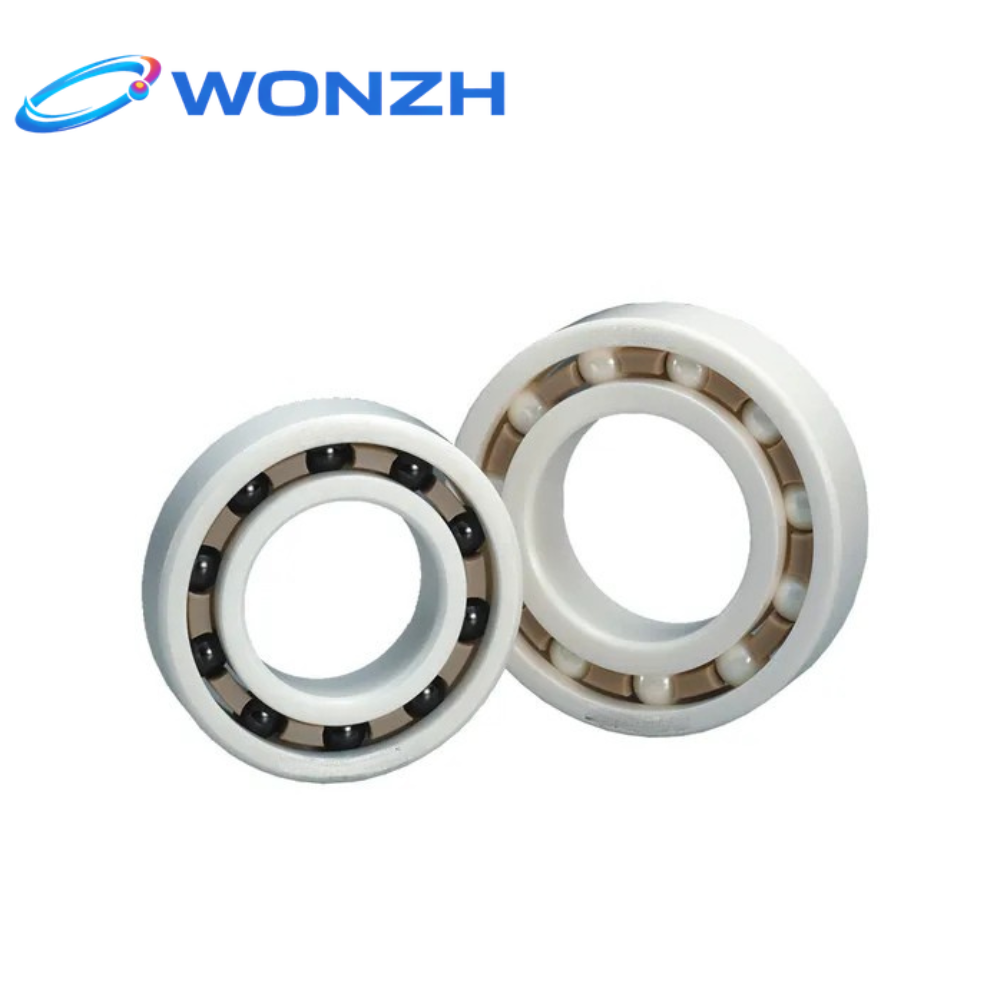
Ceramic bearings, particularly those made from advanced materials like silicon nitride (Si₃N₄) and zirconia (ZrO₂), offer superior high-temperature resistance and stability, making them an increasingly important solution in industrial systems.
1. Why High Temperature Performance Matters in Bearings
Bearings are critical components in rotating machinery. When exposed to high temperatures, traditional bearings may experience:
- Lubricant degradation or evaporation
- Increased friction and wear
- Dimensional instability due to thermal expansion
- Reduced hardness and fatigue resistance
- Premature failure in continuous operation
In industrial systems, even minor bearing failure can lead to costly downtime, safety risks, and equipment damage. Therefore, thermal stability is a key design requirement.
2. Superior Thermal Stability of Ceramic Materials
Ceramic materials exhibit excellent structural stability at elevated temperatures. Unlike metals, they do not soften or lose hardness easily under heat.
Key properties include:
- High melting point (often above 1,200°C for silicon nitride)
- Low thermal conductivity (reduces heat transfer to surrounding components)
- Excellent resistance to thermal shock
- Stable crystal structure at high temperatures
This allows ceramic bearings to maintain performance where steel bearings begin to degrade.
3. Reduced Thermal Expansion for Better Dimensional Accuracy
One of the most important advantages of ceramic bearings is their low coefficient of thermal expansion.
ΔL=αL0ΔT
Where thermal expansion depends on material expansion coefficient (α). Ceramic materials have a significantly lower α than steel, meaning:
- Less dimensional change under heat
- More stable clearance between rolling elements and races
- Reduced risk of seizure or excessive preload
This is especially important in precision machinery operating at high speeds and temperatures.
4. High Hardness Retention at Elevated Temperatures
Steel bearings lose hardness as temperature increases, which reduces wear resistance and load capacity. Ceramic materials, however, retain their hardness even under extreme heat.
Advantages include:
- Stable wear resistance at high temperatures
- Reduced surface deformation
- Longer operational lifespan
- Improved resistance to abrasive conditions
This makes ceramic bearings suitable for continuous-duty industrial environments.
5. Superior Oxidation and Corrosion Resistance
At high temperatures, metals are prone to oxidation and surface degradation. Ceramic materials are chemically inert, which provides strong resistance against:
- Oxidation in high-temperature air
- Chemical corrosion in reactive environments
- Surface degradation in harsh industrial gases
This is particularly beneficial in:
- Chemical processing plants
- Furnace equipment
- Gas turbines
- Petrochemical systems
6. Performance Without Conventional Lubrication Limitations
Lubricants used in steel bearings degrade rapidly at high temperatures, leading to increased friction and failure risk. Ceramic bearings reduce dependence on lubrication due to:
- Lower friction coefficient
- Smoother surface finish
- High wear resistance
In some high-temperature applications, ceramic bearings can operate in:
- Dry conditions
- Minimal lubrication environments
- Vacuum or controlled atmospheres
This greatly expands their industrial usability.
7. Thermal Shock Resistance in Dynamic Systems
Industrial equipment often experiences rapid temperature changes. Ceramic bearings demonstrate excellent thermal shock resistance due to their:
- Low thermal expansion
- High mechanical strength
- Stable microstructure
This allows them to withstand:
- Sudden heating and cooling cycles
- Start-stop industrial processes
- High-speed thermal fluctuations
Such properties are essential in aerospace and high-speed manufacturing systems.
8. Reduced Friction and Heat Generation at High Temperatures
Because ceramic materials have low density and smooth surface properties, they generate less friction compared to steel bearings. This leads to:
- Lower operating temperatures
- Reduced heat accumulation
- Improved energy efficiency
- Longer system lifespan
This creates a positive feedback loop where lower friction reduces heat, and lower heat further improves performance.
9. Industrial Applications of High-Temperature Ceramic Bearings
Due to their superior thermal resistance, ceramic bearings are widely used in:
- Aerospace turbine engines
- Steel and metallurgy equipment
- High-temperature electric motors
- Chemical processing machinery
- Industrial furnaces and kilns
- Semiconductor manufacturing systems
In these applications, reliability under heat is critical for continuous operation.
10. Future Development Trends
With increasing demand for high-efficiency and high-temperature industrial systems, ceramic bearing technology continues to evolve. Key trends include:
- Hybrid ceramic-steel bearing designs
- Advanced surface coatings for extreme environments
- Improved fracture toughness ceramics
- Integration into smart predictive maintenance systems
- Optimization for high-speed + high-temperature dual conditions
These innovations are expanding the role of ceramic bearings in next-generation industrial systems.
Conclusion
Ceramic bearings provide exceptional high-temperature resistance compared to traditional steel bearings, making them a key component in modern industrial systems. Their ability to maintain hardness, dimensional stability, and low friction under extreme thermal conditions ensures reliable performance in demanding environments.
As industrial applications continue to push toward higher temperatures, faster speeds, and greater efficiency, ceramic bearing technology will play an increasingly important role in improving system durability and operational safety.